

Lost the Plot
All sentences lead to Cozumel

Working too hard can dull a person’s creative faculties. This partly explains why the last Substack Octopus, the one about the murder of Taylor Swift, didn’t quite cohere. The premise of the story for those who didn’t read it and never will is the following. I tried to imagine a world in which everyone is assigned a hologram that resembles and acts like Taylor Swift. This hologram-version of Taylor is called the Taylor4u. The technology has spread throughout the entire world. Taylor4u provides customized consumer tips, dependable therapy services, companionship on demand, witty banter, dating advice, wardrobe recommendations — even live music. Although the story doesn’t explicitly say so, Taylor4u exists so that no individual can ever fully leave the consumer-capitalist matrix. There will always be a physical presence to pull them back — in a calm, friendly, cool, super-positive way. Then something very strange happens. Just as the adoption of this cutting-edge technology has reached its peak, dead people start appearing all over the world. They walk around, as real as you or me, except with one critical difference. Whenever the Taylor4u hologram appears behind them, trying to catch their attention, the dead people remain completely indifferent. They couldn’t care less. This situation is so vexing to the corporation that invented the Taylor4u that the executives come up with a drastic solution. They decide that Taylor Swift — the real Taylor Swift — must die. If they kill her and embed sensors in her body, including inside her decomposing brain, they will learn the mystery of the dead. They will apply their ingenuity to solving the problem of the dead’s indifference to Taylor. When they do so, Taylor4u will have have dominion in the afterlife as well as on this mortal plane. The corporation selects a young man called Daniel Osborne for the mission. He is deeply troubled, having lost his father to a motorcycle crash and his mother to suicide. Osborne works in the kitchen at Magpie Restaurant in Edmonton, Alberta. On the eve of Game Three of the Stanley Cup final between the Edmonton Oilers and the Florida Panthers, Osborne marches out of the restaurant kitchen and into the dining room, where Taylor Swift is at a gathering of local luminaries, including the mayor. Obsorne fires three rounds from a 3D printer gun, and a volcano of blood erupts from Taylor’s shattered chest. The first person to arrive on the crime scene is a television breakfast show host. She becomes the one to narrate the news of Taylor’s death to the world.
My creative faculties were strained when I wrote this. I became impatient. I did two completely different drafts but that wasn’t enough. I doubt the content was appropriate for a Substack post. I keep picturing a movie instead. If anyone reading this has an extra $100 million gathering dust in the attic, I would love to invest it in a full-scale production that will allow me to create a convincing Taylor Swift hologram. I would love to be able to film on location in Edmonton and on the Wirral peninsular. A movie would do it justice, I feel sure of it. A bit of billionaire cash would come in handy.
Fiction is hard. It’s the harshest taskmaster that I know of. You can’t simply make things up. You have to fight harder than anyone else to earn attention.
Your neighbour will tell you that raking the leaves will kill precious worms that live in the soil and so you should refrain. That’s an interesting and memorable observation. CIBC calls to say you missed a payment on the Visa card. That’s an urgent matter requiring instant attention. Your three-year-old screams at you for thirty minutes straight that she does not want to go to daycare. No, daddy, no no no! She is impossible to ignore. But some weirdo comes at you with a story, speaking of things that never actually happened for real? Please! Make me care!
There is an aphoristic style that I wish I could slip into, like putting on comfortable walking shoes that have picked up plenty of street scuffs, and if I could do that, I’d have a better shot of being consistently entertaining. Yet I cannot. I went to the Church of the Hardy Boys, in which all the mysteries from the beginning of the book are solved by the end. I cannot help it. I need longform structure. At the end of Crime and Punishment, Rasknolnikov confesses his sins. At the end of L’Étranger, Meursault dreams that “there be a large crowd of spectators” on the day of his execution, and that they will greet him with “cries of hate.” Very satisfying. In our own tepid century, Kazuo Ishiguro has overcome the inertia of our cultural stagnation to contrive absolutely perfect plots. The Unconsoled is a long fever dream about an artist’s delusion of grandeur. It torments the reader. It won’t let you go. As Susan Sontag wrote many years ago, “People who read for nothing else will read for plot.” There is a deep human craving to find out what happens next. It pre-dates the invention of the novel. It is in the epic poems that were passed down from one orator to the next. It is in ancient theatre.
And yet there are now legions of people who struggle to pay attention to any narrative artform — novels, television, film. Even on Substack, in which long-form is received favourably, any time a writer departs from the usual “take” on a topical issue, that writer is very likely to see a drop-off in interest — and it’s not simply a matter of them launching a dud, as I did on Monday. (See below Sam Kriss’ usual annual review of his year in writing. The supernaturally prolific Justin Smith-Ruiu has reported similar experiences.) One of the best pieces of writing Kriss ever produced on this platform is, in my opinion, “There’s someone on the ice,” which came out on January 18, 2025, and is the kind of story that lingers long in the memory. The story was well timed to play on fears about the possible annexation of Greenland by Donald Trump. But it wasn’t a “take.” It was something else entirely. To follow that story, you had to sit for a while and be patient. The second paragraph consisted of nothing but description. It was 313 words long. It established a setting, Greenland, and its unique properties, such as the fact that mining is all but impossible because of the ice, and that the United States military once tried to build a base there. When I entered the text of that paragraph into the online Hemingway app, it received a readibility score of 7. Four out of the twenty sentences were deemed “very hard to read.” The second paragraph introduces the first of several characters: “The first documented encounter with the icedwellers was filmed by Jaxon Flores, an American settler, just outside his homestead above Qikangittuqaqquti on the edge of the ice.” By this point, a reader is becoming aware that Kriss is asking for patience and persistance; things are going to get complicated; it will be necessary to retain the names of characters and their relationships to each other; it will be necessary to remember particular events that happen so that subsequent events will make sense. In short, it will be necessary for a reader to hold a fairly elaborate structure intact in their mind — at least for about forty minutes. Kriss is popular on Substack, which gives me hope. Yet Kriss has argued that people like him, people who care about narrative —including the literary novel — are undergoing extinction. They are being replaced by people who care mostly about short video. This is deeply unfortunate. Kriss doesn’t say this but I will: it is well known that when a person spends an hour scrolling TikTok, they have effectively become possessed by a demon. Their soul has been captured and they have to win it back somehow. It isn’t a hopeless cause. Some TikTok users can probably remember what it’s like to read. They are familiar with sentences such as this one, “Your perfect escape to the ‘Land of the Swallows’ is just a flight away!” But it’s a Herculean struggle to save someone whose mind has been doped by TikTok and to bring that person back to the world of Hemingway (the real Hemingway). Online sentences are continually being buttressed by the image. The online sentence becomes an adhesive that fixes the image to a specific function. Land of the Swallows refers to Cozumel, Mexico. Want to go there. FlyTastic says tix are going down in price. Book now. Done. New sentence. The buttressing of the sentence by the image provides succor and encouragement to the beleagured twenty-first century denizen. For many, consuming is the only function they expect from the sentence. Sentences hold the images together so you don’t accidentally book a flight to Lagos instead of Cozumel. This is why it’s so easy to outsource the job of sentence-making to AI. The phone has access to almost all the sentences ever written in the history of humanity, the beautiful ones as well as the mundane and stupid ones. I can has cheezburger. The phone eats the endless word-hoard of sentences that has been accumulating since the dawn of time. It grows in power demonically. The ring that rules them all. No mere mortal could ever compete. You are now in Cozumel, Mexico, because you clicked the button that said BUY NOW.
The job of the writer is to fight against all that and to give the audience what they do not want.
There is a line from Rachel Cusk’s Outline that I have never been able to forget — “Writers need to hide in bourgeois life like ticks need to hide in animal’s fur: the deeper they’re buried the better” — and it resonates for me, not only because it’s a way to excuse the relative passivity with which I’ve approached my life. It would be easy to take the self-deprecating interpretation: that living so close to a sleazy, depressing shopping mall along with the costs and headaches of owning two motorized vehicles are consequences of earlier events, and the best thing that could be said about them is that all my apparent non-choices did not rule out still being able to live well or, most importantly for my purposes here, to write. In other words, one could still be a serious writer in Edmonton, even if it had at one time seemed to me that you had to work from New York, Berlin, Paris, or at least Montreal. One of those serious, cosmopolitan cities. (Cusk herself has written chiefly from serious places like Athens and the more densely populated portions of the south-east of England; never from some obscure place like Rotherham or Saint-Éloy-les-Mines or Medicine Hat.) Yet now, being fifty, I have fully accepted that the place you are in really doesn’t matter. You might more reliably and predictably feel enchantment with the world in the Jardin du Luxembourg or from the top of Mount Royal, but if you’re chasing enchantment, you’re missing the point. The enchantment is everywhere. Crossing Edmonton’s Walterdale Bridge at sunrise as my daughter calls to me to watch the ducks paddling on the North Saskatchewan River; walking around the neighbourhood of Highlands, Marshall McLuhan’s former stomping ground, as my eyes move from a fancy carriage house to the view across the river valley and refinery row in the distance; congregating at Little Brick Café in Riverdale with the friendly dogs and the weary cyclists relaxing their bodies. All these are thin places where enchantment can pour in and I can forget, for an hour, the mortage rate, the salary negotiations, the shitty thing I said this morning that I now regret. Demmi Nace found the enchantment on the London Underground: “The greasy rail, the body odour, the strangers pushing up against each other in silence, the sounds of tube announcements of delays due to heat, everyone desperate to not be there. It was unbearably painful, and it felt like that thick veil between the tube, between London and heaven, ripped a tear from all the pressure, and God’s light came in.”
All places are connected because they are of the same world, and also manifestations of the same Word. With the word, you can tear a hole in the space-time continuum. Edmonton matters more than anywhere else, and just as much as everywhere else, because it contains within it everything that could ever be said about everything.
And I get to live and write here!
So, onwards with the serious job of making worlds from the Word.
“Try again. Fail again. Fail better.”1
NOTES
There are 47 days left in 2025. How will we spend them?
Sources
Socrates on the Invention of Writing and the Relationship of Writing to Memory, History of Information.com
https://www.historyofinformation.com/detail.php?id=3439
“There’s someone on the ice,” Sam Kriss, January 18, 2025
“Three years of apathy, lassitude, and failure,” Sam Kriss, September 17, 2025
“We’re Doing ‘Men Don’t Read Books’ Discourse Again. Here’s What We’re Missing,” Jason Diamond, August 9, 2024
https://www.gq.com/story/were-doing-men-dont-read-books-discourse-again
“Is London a thin place? A love letter to the worst place on earth,” Demmi Nace, May 15, 2025
“The modern discourse novel,” Henry Oliver, July 2, 2024
Image
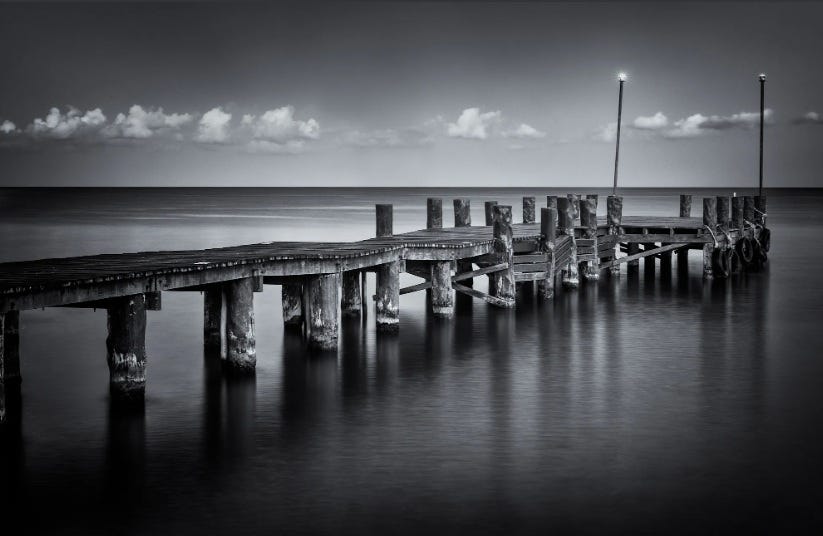
Cozumel, Mexico in Black and White
https://www.danieljoderphotography.com/cozumel-mexico-in-black-and-white/
Samuel Beckett