

Progressive Cultural Weakness
The omniposition is eroding trust and credibility

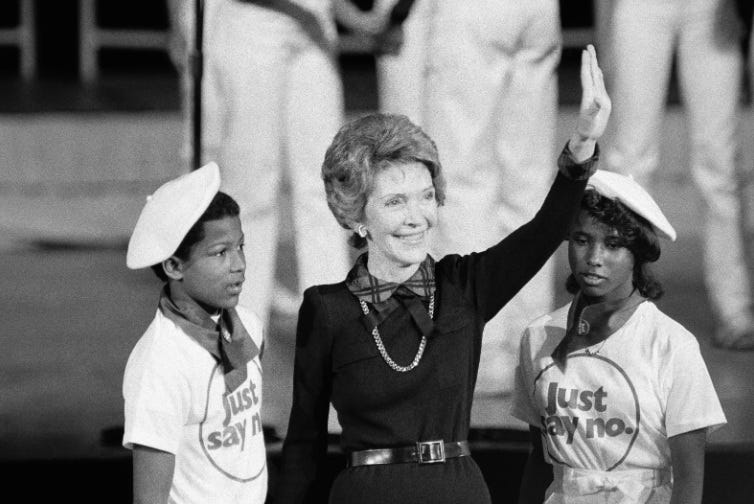
When I was growing up, Nancy Reagan became famous for spearheading the “Just Say No” campaign against illegal drugs. At the time, the United States was in the midst of a crack-cocaine epidemic. Being the wife of the president gave Nancy Reagan a huge platform. She travelled across the country to public events and appeared on television and radio, popularizing a youth-focussed campaign that promoted a clean, wholesome message. Just Say No became an easily remembered mantra. The percentage of Americans who saw drug abuse as the nation's "number one problem" surged, from around six per cent in the mid-eighties to 64 percent by the end of the decade. Whether a significant number of youth spurned drug use because of Nancy Reagan, I do not know.
Just Say No was the sunny side of a much darker campaign: the weaponized war on drugs, which took the battle to the cartels of South America and Latin America. Just Say No was ostensibly apolitical but culturally it was right-wing. It was hopelessly square, because back then, right-wingers were also hopelessly square. Over on the other side of the Atlantic, my friends and I found Just Say No hilarious and we openly mocked it. Nancy Reagan made drug-taking seem cool. The broader cultural forces were not on her side. By the time the erstwhile dope-smoker Bill Clinton was in the White House, the appeal of drugs was only continuing to grow thanks to Cypress Hill, Snoop-Dogg, and countless others. Fast forward to our current era, the widespread ingestion of illegal drugs and the abuse of prescription drugs are inescapable scourges of the American landscape. Canada is in the grip of its own drug epidemic. Another campaign like Just Say No is unthinkable.
The long-term failure of Nancy Reagan’s farcically simple campaign carries a lesson that has been widely ignored by progressives. In fact, the progressive movement has become the Nancy Reagan of the 2020s, albeit with a touch more menace. We are experiencing a nightmarishly protracted Nancy Reagan moment. Progressives have adopted a non-negotiable “omniposition” on a set of complex issues and want the broader public to Just Accept It. Yet despite having majority influence over most postsecondary institutions, vast swathes of the entertainment complex, and most members of the professional and managerial classes, the omniposition is increasingly fragile. Just Accept It isn’t working.
You will know the specific demands of the omniposition by whatever the conservative movement is against, both north or south of the border. My aim here isn’t to examine the specifics of the omniposition. Whether the issue is climate change, immigration, crime, gender identity, or any other, progressives are losing on almost every front. Not only are they losing politically, they are losing culturally.
It used to be the case that progressives were politically impotent but left-wing culture was vibrant and interesting. This is how it was when I was growing up. Margaret Thatcher and Ronald Reagan were in charge of the Anglosphere. Yet we still had the music of the Dead Kennedys and The Clash; spiky, uncompromising films like How to Get Ahead in Advertising or Wall Street; acerbic comedy like The Young Ones, and so on. There was a DIY aspect to much of left-wing culture. Ink a Dead Kennedys badge and sew it onto your jacket. Even if given access to elite institutions like the BBC, left-wingers were not neutered. Filmmaker Adam Curtis owes his entire career to being a spinner of disruptive narratives with implications that are best suited to a left-wing response. And yet Curtis has had the entirety of the BBC’s archives at his disposal for decades.
Personally, I don't mind if left-wing ideas fail to hold sway through mainstream channels. What I mourn is the increasing irrelevance of progressive culture at the grassroots level. Currently all the vital culture is on the side of the right. Charlie Kirk founded Turning Point USA at the age of eighteen. Now he is dead it is clear to all that his influence was enormous. That influence will likely grow because the manner of his assassination will be so strongly motivating to the right. Other notable influencers on the right have built their own empires from unlikely beginnings. No one who watched Fear Factor when it debuted in 2001 would have suspected that Joe Rogan would subsequently amass one of the largest online audiences on the planet.
The right wing loves its leaders and its influencers with a passionate intensity that is absent on the left. Only a corporate CEO or an investment manager would have loved Kamala Harris. As for leaders who skew slightly more left than Harris, say Canada's Jagmeet Singh, I don't see much love for him in the wake of the NDP’s recent electoral disaster. Left-wing leaders are not connecting with voters. It is not only because they have abandoned the working class. It is also due to their insistence on the “omniposition,” which is presented to voters with the unspoken yet tacitly understood message: Just Accept it.
One of the issues on which the left has utterly lost the plot is free speech. It used to be that the right was censorious and sanctimonious. Now it's the left that is censorious and sanctimonious, while the right revels in rebellion and subversion. On September 13, Elon Musk made a video appearance at the Unite the Kingdom protest in London, which was organized by the far-right thug, Tommy Robinson. Musk made this appearance while proudly wearing a George Orwell t-shirt, taking on the role of a free speech warrior. Obviously this was an outright con but it was a convincing one because most of what passes for the contemporary left simply does not believe in free speech anymore, having conceded the issue to the right. You can't spend over a decade instrumentalizing the postsecondary system, turning it into a place to inculcate correct thinking, and at the same time uphold Orwell’s legacy. Orwell was a democratic socialist and yet modern-day progressives have all but disavowed him.
Canada's left started to make earnest efforts to rid itself of wrong thinking after the election victory of Justin Trudeau in 2015. There is a sad chapter in Canadian history that most so-called progressives would rather forget. In 2018, the Trudeau government changed the rules of its Summer Jobs Program, requiring that all participating employers complete an attestation pledging that they would respect the rights set out in the Charter of Rights and Freedoms, including women’s right to reproductive freedom. Exactly one MP from the federal New Democratic Party, Nathan Cullen, joined with Conservatives in condemning the move. He said, "I think it's offensive to some Canadians because it's saying: 'if you hold these values, you are not worthy of any government funding even if the work that you're doing supports the Charter, supports the general values that Canadians hold... It seems to be driving a wedge on something that we needed no wedge drawn on.”
Some NDP apparatchik must have taken Cullen into a back room somewhere and told him in no uncertain terms that he better conform to correct thinking. Within hours he was issuing an apology for the “harm” his comments had caused. This is one of the swiftest U-turns in political convictions I have ever seen.
When Cullen criticized the changes to the Summer Jobs Program, he wasn’t saying that the NDP had ceased to be a pro-choice party. He was merely pointing out that a federal spending program shouldn’t require employers to sign a public pledge of allegiance to the social values of the ruling political party. No matter. For the NDP, adherence to the omniposition was non-negotiable. It didn’t matter that many on the left had at one time drawn some of their political principles from their religious beliefs; in the new version of the left that had cohered by 2018, all traces of religiosity and traditional values were to be swept away. Just Accept It.
Before the Government of Alberta started going after public school libraries for supposedly questionable material, bureaucrats with different motivations but similar methods had done the same in Toronto. In 2023, the Peel School Board, as part of its “equity-based book weeding process,” removed up to fifty per cent of books from the shelves of public schools. When the results of this weeding process became apparent at the start of the fall semester, it was clear that books published before 2008 had been particular targets of the cull. The CBC interviewed parent, Reina Takata, about her dismay at finding so many books gone. “I think that authors who wrote about Japanese internment camps are going to be erased and the entire events that went on historically for Japanese Canadians are going to be removed,” she said.
Making 2008 “Year Zero” for the purposes of disseminating acceptable values to youth is a recognizable tendency of the broader progressive movement. For them, history is a cauldron of fetid and obsolete ideas that we must overcome. This disdain for the past is matched only by the algorithmic ruthlessness of “content creation.” This is why a lot of contemporary children’s literature is at a deplorably low standard. I’ve included a few high-level articles in the links below, which provide overviews of this situation. My guess as to why it is so bad — so saccharine, so crude, so unbearably preachy while being flat and pointless — is that many progressive people today mistake books for “information.” Just like Nancy Reagan, they seem to believe that imparting an inspiring message is sufficient for that message to take root.
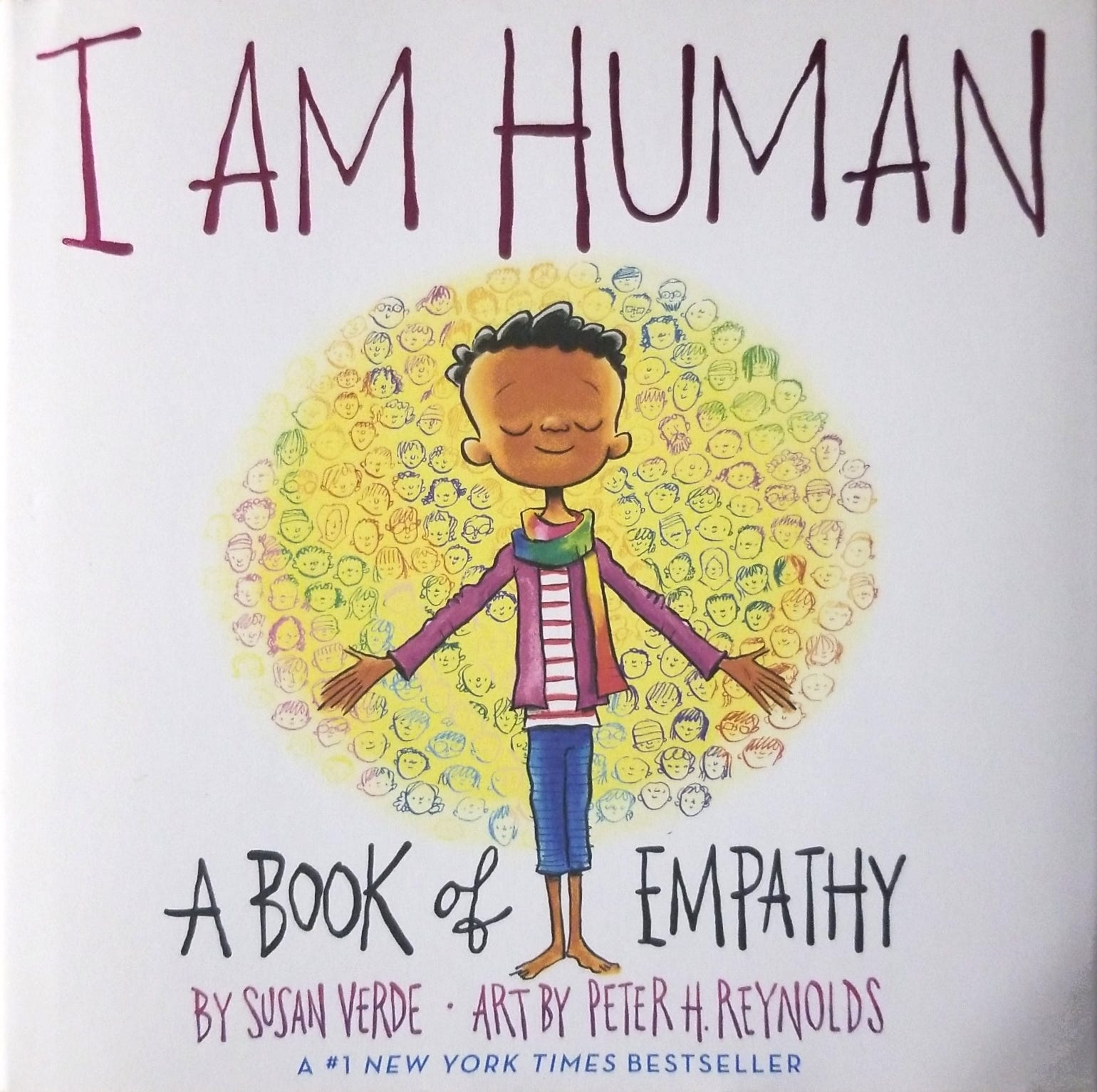
This is how we end up with books like I Am Human: A Book of Empathy, a New York Times bestseller. Nothing happens in this book, nothing at all. It’s simply a series of statements written in the first person. On one page, the kid is under water, reaching out to touch a fish. The accompanying text reads "I have a feeling of wonder. I am amazed by nature." On the next page, the kid has on a horse costume and is dressed as a knight, and is running after a girl who is also dressed as a knight. The text says, “I have a playful side. I find joy in friendships.” It just keeps going like this. There is no rising tension, no conflict, no structure. It is all utterly unmemorable.
Disney’s retelling of old classics suffers from exactly the same flatness. In the book, Meet Ariel and Friends, the story of the Little Mermaid has become insipid and lifeless. The book does nothing more than introduce Ariel, her father, other family members, and the various fish and underwater pals that she hangs around with. When Tantie Ursula appears, all we are told about her is that she is great at magic. But we don’t see her doing magic. We are not given a front-row seat to the exciting verbal and physical pyrotechnics that magic can entail.

There is nothing enchanting about any of this. The spellbinding power of language is being completely denied. The old Bard, if you could still find his works on the school shelves, would have a few lessons to share.
Double, double toil and trouble;
Fire burn and cauldron bubble.
Fillet of a fenny snake,
In the cauldron boil and bake;
Eye of newt, and toe of frog,
Wool of bat, and tongue of dog,
Adder’s fork, and blind-worm’s sting,
Lizard’s leg, and howlet’s wing,
For a charm of powerful trouble,
Like a hell-broth boil and bubble.
I could recite this verse to my children and ignite more curiosity than by reading a thousand contemporary children’s books, in which all that matters is telling them how to be good.
“We’ve replaced collective experience with atomisation. Without getting too nostalgic, programmes like the BBC’s Generation Game once pulled in millions every Saturday night, giving us something we could all talk about on Monday morning. Now we watch Netflix, Disney+, Prime, or Paramount, alone, in algorithmic silos.” Clive Lewis, MP
Governance under a hegemonic progressive elite feels like the regular deployment of new software code in an attempt to recalibrate the human experience and to tweak it toward “desirable” ends. This deployment happens at the level of the individual. Yet culture is supposed to be a collective experience. In his response to the Unite the Kingdom protests, Clive Lewis was on point.
How can it be — with Netflix deploying content that celebrates diversity, educating viewers about crimes and injustices of the past, and airing countless documentaries revealing contemporary wrongs that must be righted — that humans are failing to update their operating systems correctly? Why are they in the streets of one of the world’s cosmopolitan centres in thrall to the words of renowned bigots?
After the 2024 presidential election, Joseph Heath (co-author of The Rebel Sell), noted the rise of virtue signalling in American culture. “It is apparently no longer sufficient to advance progressive values, one must also draw attention to the fact that one is advancing progressive values,” he wrote. He looked in particular at the success of the film, Brokeback Mountain. His argument is that the widespread popularity of the film was misread by progressive elites. Its success did not mean there was a broad-based allyship among the broader public with same-sex couples. Rather, the film “quite explicitly tied the struggle against homophobia to a set of universal themes,” notably the desire to live freely as one pleases. Misreading the success of the film and the broader success of same-sex marriage, progressives sought to advance the frontiers of their project. They were adding new features to the omniposition. Unlike the fight for marriage equality, the point of the omniposition wasn’t to free up individuals to enjoy the rights that had been denied to them; it was nothing short of a transformation of society, with a rejection of customs and norms that had endured for centuries. And you couldn’t opt out of any part of the omniposition because the omniposition refused to offer itself up for debate.
Proponents of the omniposition fail to see its rigidity because they are inside it, looking out. They are like the first-person player of a video game. They will say, how can you expect the federal NDP, the most left-wing of our current political parties, to be anything but ardently pro-choice? We cannot defend our base while compromising on this point.
What is missing is nuance. Clearly, the NDP will forever be a pro-choice party. But there is a broader principle to uphold. Brian Bird wrote for Policy Options during the Summer Jobs controversy: “It is troubling when the state coerces citizens to think as it does on controversial moral issues. This tactic is expected in undemocratic states. It is concerning to witness it in a liberal democracy like Canada.” Progressives are foolish to create the apparatus for state coercion that can just as easily be wielded against them when they are out of power.
In 2020, well before I had suspicions about the advancement of the omniposition, I was enjoying a comfortable little niche that I had built for myself on the platform formerly known as Twitter. Because my then-literary agent was a person of refinement, good taste and considerable online clout, I benefitted from my association with him. Soon I was connected to an international cohort of talented writers, critics, philosophers and artists. I remember once exchanging tweets with Lisa Robertson, author of the Baudelaire Fractal. It was very rewarding.
That year, or perhaps the following one, I started reading The Black Jacobins by C.L.R. James. The book, written in 1938, is a history of the successful slave revolution in Haiti, led by Toussaint L'Ouverture. The vividness with which James had described the brutality of the slave system had a profound physical impact on me. It almost provoked a panic attack. I mustered up the courage to go to Twitter, type a few excited comments about my experience, and then I went back to reading. A few hours later, I went back to the trapline to see what had come in. A Chicago-based artist, who had always been very convivial with me previously, announced that they were disappointed by how much James, as author, had venerated the physical courage and prowess of Toussaint L'Ouverture. It came off as ableist.
This was not the first time I had seen the word ableist flung about. It was a charge leveled against me by exactly one person when I published my novel Blind Spot. (The charge was based purely on the book’s title.) What I had learned from that experience, I applied to this fresh experience. I knew there was no point engaging in a debate. I would just be told to educate myself and to correct my thinking. I thanked the Chicago artist for sharing their opinion and I shut up.
I admit though that I was quietly horrified. I could not accept the artist’s objection. Toussaint L'Ouverture is clearly a towering historical figure. His military acumen, political smarts — not to mention his physical bravery — are crucial to the story of the Haitian revolution. I do not see how an account of these qualities can be omitted from the record.
This was one of many turning points in my understanding of the omniposition. I became suspicious of the perpetual undercurrent of passive aggression that threatens to drown anyone on the left before they have even opened their mouth or typed a word. Here we have an entire movement fuelled by anxiety about saying the wrong thing. No wonder managers love it. What a joyless movement it has become. But now I realize the much larger collateral damage is to the culture itself.
The Nancy Reagan moment will not survive. But as with the war on drugs, there will be a lot of damage done before it is over.
NOTES
While a huge number of contemporary books for children are dull and boring, there are some notable exceptions. Princess Cora and the Crocodile merits a shout-out here.
Sources
“Just Say No.” History.com
https://www.history.com/articles/just-say-no
“Nineteen Eighty-Four Was Written by a Socialist,” Chandler Dandridge, February 12, 2023
https://jacobin.com/2023/02/george-orwell-1984-prager-university-socialism
“NDP's Nathan Cullen adds his voice to those condemning Trudeau government's summer job abortion stance,” Peter Zimonjic, CBC News, Jan 24, 2018
https://www.cbc.ca/news/politics/nathan-cullen-summer-job-abortion-1.4502634
“NDP MP Nathan Cullen apologizes after critique of anti-abortion job grant changes,” Lee Berthiaume The Canadian Press, January 25
https://globalnews.ca/news/3987039/ndp-nathan-cullen-apology-anti-abortion-canada-summer-jobs-grant/
Omniposition, Urban Dictionary
https://www.urbandictionary.com/define.php?term=Omniposition
"'Empty shelves with absolutely no books': Students, parents question school board's library weeding process," Nicola Brockbank, Angelina King, CBC News, September 13
https://www.cbc.ca/news/canada/toronto/peel-school-board-library-book-weeding-1.6964332
Macbeth, Act IV, Scene I [Round about the cauldron go]"
https://poets.org/poem/macbeth-act-iv-scene-i-round-about-cauldron-go
Children’s literature has lost the plot: Are we teaching toddlers to read without teaching them to think?
https://unherd.com/2020/03/childrens-literature-has-lost-the-plot/?ref=refinnar
Why are children’s books so ugly?: The state of illustrated kids' books makes one thing clear: we do not value beauty:
https://unherd.com/2020/03/why-are-childrens-books-so-ugly/
Clive Lewis MP
https://x.com/labourlewis/status/1966988870890963361
“How Steve Bannon baited the American left into overplaying its hand,”Joseph Heath, November 14, 2024

Canada Summer Jobs and the Charter problem, Brian Bird, Policy Options, January 16, 2018
https://policyoptions.irpp.org/2018/01/canada-summer-jobs-and-the-charter-problem/
Images
Pop-Culture Legacy of Nancy Reagan's 'Just Say No' Campaign, Tessa Stuart, Rolling Stone, March 7, 2016
https://www.rollingstone.com/culture/culture-news/pop-culture-legacy-of-nancy-reagans-just-say-no-campaign-224749/
The images from the children’s books were taken by me.
"checking the trapline": I laughed out loud!
"This is why a lot of contemporary children’s literature is at a deplorably low standard. I’ve included a few high-level articles in the links below, which provide overviews of this situation. My guess as to why it is so bad — so saccharine, so crude, so unbearably preachy while being flat and pointless — is that many progressive people today mistake books for “information.” Just like Nancy Reagan, they seem to believe that imparting an inspiring message is sufficient for that message to take root."
Yes indeed. I co-host a podcast on children's horror and while there are notable exceptions, I find the children's literature we cover from the 60s through the 90s is so much richer than contemporary literature because of a willingness to be non-didactic, poetically obscure, weird and sometimes troublesome.