


The Shadow City Interviews are part of a larger project, Who’s Afraid of Edmonton?, in which, together with long-time residents, I explore the good, the bad, the ugly — and the sacred — in the city.
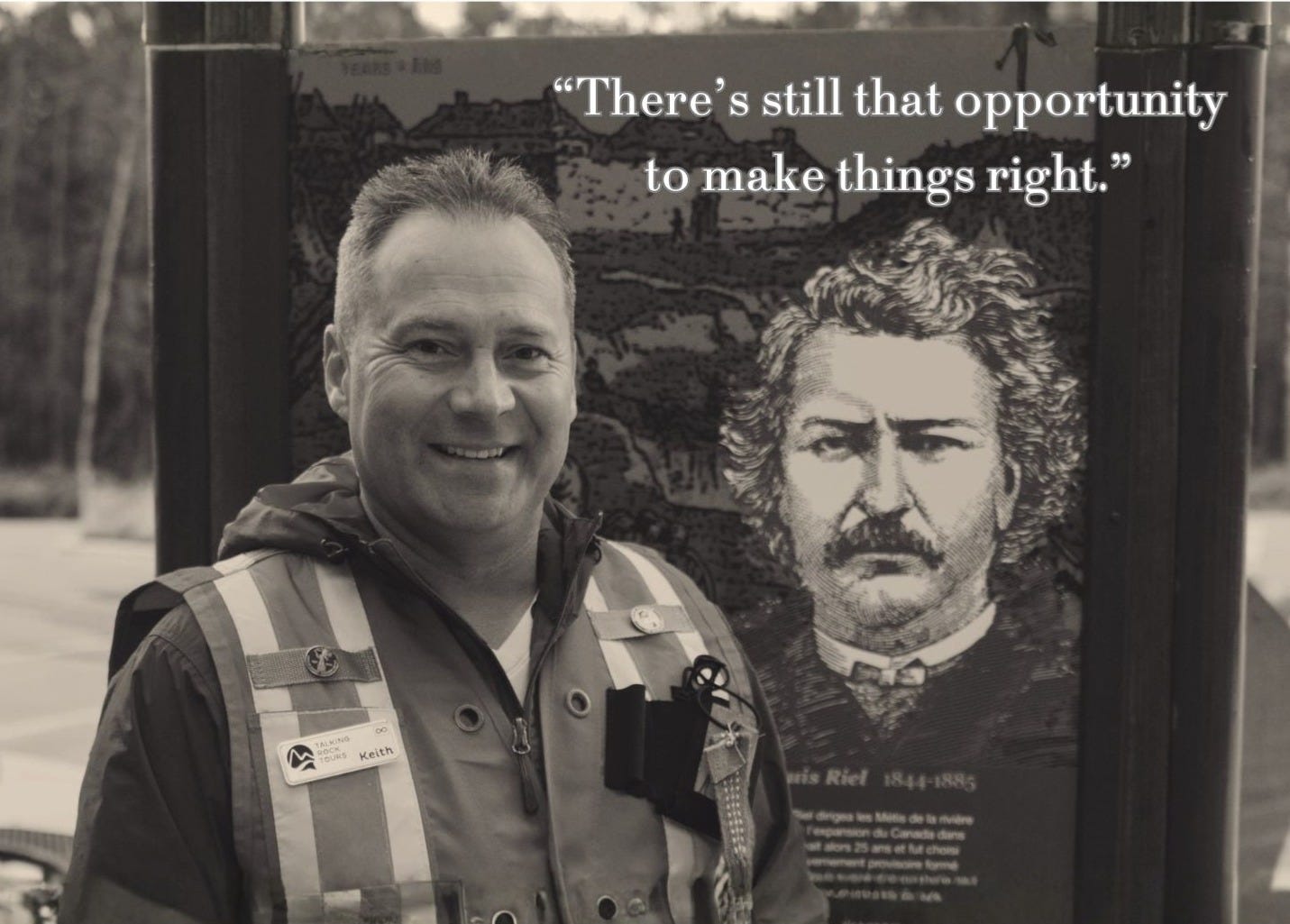
Keith Diakiw
As a professional geoscientist and recent Fellow of Geoscientists Canada, Keith Diakiw operates Talking Rock Tours while serving part-time as a Naval Warfare Officer with His Majesty’s Canadian Ship (HMCS) Nonsuch in Edmonton, Alberta. He served as the Northern Environmental Coordinator for the 3rd Canadian Division Support Group from 2022 to 2025. Lt(N) Keith Diakiw also served as an Environmental Officer for Exercise Arctic Bison 25, where he fostered respectful relationships with Haa Shagóon Hídi, the Carcross/Tagish and Tlingit First Nations, contributing to cultural engagement and reconciliation efforts.
Keith is active in the Indigenous Tourism scene as founder and Geo Experience Officer of Talking Rock Tours. He was featured in the Globe and Mail for his work conducting memorable geo-experiences to learn about the natural and cultural history of geological wonders in Alberta. He serves as a Board Member of Indigenous Tourism Alberta, a Special Advisor to the Explore Edmonton Indigenous Advisory Circle, and was recently elected as the new Military Co-Chair of the Defence Indigenous Advisory Group for Alberta.
(The following interview was recorded on March 26, 2026. The transcript has been edited for length and clarity, with some small revisions made on April 8.)
What is your personal connection to Edmonton?
My personal connection to the city of Edmonton began 30 years ago. I graduated from the University of Lethbridge and was on the journey of being a professional student for a while. I knew my next big step in life was to get my geology degree. I attended the University of Alberta in 1996. That led to meeting my wife, but before that, joining the military. I always had that yearning to join the Canadian Armed Forces. I joined the Royal Canadian Navy in 2001. While that journey was going on to finish my trade training as a naval warfare officer, I became a professional geoscientist. My wife and I got married in 2008, and that’s really where we planted our family roots and had our three children. And I’ve created my first business here, in Indigenous tourism.
You know, as you evolve in your career you realize money is not everything. That was what I felt after 11 years in the oil sands. To go from a six-figure job to zero, you’d think I would have been devastated, but it felt like a house was lifted off my back. Now having children and trying to lead by example, I wanted to take that journey with Talking Rock Tours.
Talking Rock Tours really got me to learn about my Métis ancestry. We learned very little about Canadian history in the K-12 curriculum for my generation. From some of the latest research I’ve done, I hear a lot of stories that are not in the textbooks. I learned who my ancestors were, where they came from, and how their stomping grounds spread from the Red River Settlement all the way to Edmonton House or Fort Edmonton. This literally is the homeland of my ancestors. I’m just the continuation of that, the appreciation and the gratitude to Mother Earth for all the gifts from the prairies.
My heritage being part French, part Ukrainian, proud Métis, it’s been really eye-opening that by marriage I am connected to the Dumont family. When I think of Gabriel Dumont, Louis Riel’s right-hand man, and his sister marrying into the Ouellette family, of which I’m a direct descendant — this was their stomping ground right before the 1885 Northwest Resistance. From Fort Pitt, the border between Alberta and Saskatchewan as we know today, to what we know as Edmonton, to Winnipeg, I feel that I’m meant to be here. This is my home. I have the duty and responsibility on behalf of my Métis ancestry to be an advocate and a voice for my First Nations, Inuit cousins, and of course the Métis Nation, and to bring the stories of the land to life.
Is there something about Edmonton that you think outsiders fail to appreciate?
For me, it would be the extensive history hiding in plain sight. Even though it’s the modern-day capital city of Alberta, it’s also a continuous gathering place that spans over 11,000 years, ever since the last ice age, when Glacial Lake Edmonton drained and the animals returned and they crossed the mighty North Saskatchewan River at one of those natural low points, one of them being underneath what is now the Walterdale Bridge. Once people know, it’s hard to keep it bottled up. You want to tell so many family and friends that, you know, Edmonton is more than a shopping place. In the Rossdale community, many of them know that sacred place, the tangible evidence of the pre- and post- 18th-century birthplace of what we know today as Edmonton.
Is there a particular moment when, at a certain fork in the road, Edmonton took the right path?
Being a professional geoscientist and having that geology lens, the first thing that comes to mind is Leduc No. 1. That discovery, around Valentine’s Day in 1947, really transformed Edmonton into the oil capital of Canada and the economic engine that we enjoy today. When you think of all the refineries between Edmonton, Sherwood Park, and in Fort Saskatchewan, you can see why we have a team called the Edmonton Oilers.
But when I think of how I’ve evolved, having more of an Indigenous cultural lens in my life, I’m so happy that the City of Edmonton has protected the river valley. Maybe not so much the history and the artifacts, but the sheer vision of the preservation of our ribbon of green. The river valley has now turned into North America’s largest urban parkland — over 20 modern parks and 160 kilometers of trail. It’s literally a natural oasis for those that live and thrive in Edmonton.
Do you feel there’s a point in Edmonton history when, at a certain fork in the road, we took the wrong path?
I’m thinking from a hockey lens about the Northlands Coliseum. April 6, 2016 was the last game played at Northlands — so almost exactly 10 years ago. Wayne Gretzky put Edmonton on the map, right? And to walk by the Coliseum, it’s just kind of heartbreaking. I know that there was a time when they were going to turn it into a recreation centre. It’s right on the LRT. There was even a hotel nearby. You’ve got the Expo Centre nearby as well. To me, it’s a no-brainer to have a two-level rec centre with hockey rinks and curling rinks, to have a place where the youth can be where Wayne Gretzky played, where the Edmonton Oilers won five Stanley Cups. We’re treating it like it doesn’t mean anything. I remember as a kid watching it in Hinton, and Don Cherry, and you’d see it on TV where they would zoom out and you’d see Northlands Coliseum. Look where it is today. What do we do with it? When are we bulldozing it? Why are we going to destroy it?
Tell me about something in Edmonton that feels sacred to you.
The go-to would be the Rossdale Flats, to visit and acknowledge that sacred ancient burial ground. We were brought up Catholic. It is important to pay our respects to a holy place. That holy place is the holy Fort Edmonton Cemetery. Sadly, when you google “Alberta’s oldest cemetery,” the cemetery at Rossdale Flats doesn’t get populated. It still bothers me, and that’s why there is a fire in my belly to keep doing what I’m doing about being a voice for Rossdale, because, even to this day, it’s still being disrespected on multiple levels.
There’s still that opportunity to make things right. What better place to have the “Touch the Water” Promenade with the storyboards of the fur trade and the Métis river lots and the voyageur stories and to have drumming back in the river valley to honour the First Nations and their stories, like they do at the Okotoks Erratic site. That is the benefit of having the river valley. When you’re on that interconnected level, we call it wâhkôhtowin in nēhiyawēwin or Cree: everything is interconnected. We are all one. We are all in relation to each other. We’re not better than the bumblebees, we’re not worse than wolves. It’s very humbling to know that when you see the river valley, when you’ve had that hard day’s work in Edmonton, all of our blessings are from the land. That’s probably why Lonely Planet is almost giving us that nudge to tell our story, to make it more succinct and more powerful to present it to the world, because now with that publication we have more eyes on us.
If Edmonton had a Bond villain, past or present, who would it be?
The obvious one would be Calgary. With Calgary being this thriving metropolitan, white-collar downtown with the mountains in the background. They also stole our oil company headquarters. That would be an obvious one. Another one would be Jasper. Because when you think, what does Jasper have going for it? We lose visitors every year because everyone wants to see the iconic Rocky Mountains.
What I see as the current villain is the unexpected growth since the pandemic. I know it made history in the sense of the largest uptick in such a short amount of time. Urban and regional planning are so important. Do we not have that overall vision? We know urban sprawl is happening in every urban setting around the world, and it is a problem, and we’re trying to keep everything inside our ring road, the Anthony Henday. I’m not sure if it was the short-sightedness with the urban planners, but it just seems like we’re trying to play catch-up. It’s really difficult to pay higher taxes when we’re getting less.
For all of these newcomers and new Edmontonians, it breaks my heart. Diversity is our strength, and it’s always been that way, because this was an ancient gathering place since the last ice age. No surprise, people from all over the world want to come here because every festival, every religion, it’s all here. We’re almost treating these newcomers as second-class citizens because there are not enough services for them. But also everyone suffers, including the First Peoples and those born and raised here. We really need to see what we can do — not a reset, but a rejig.
Should other Canadians care about Edmonton and, if so, why?
Besides our ribbon of green, North America’s largest urban parkland and the proximity to Elk Island National Park where the buffalo still roam, we are the gateway to the North and a major hub for Indigenous Peoples and heritage. No surprise, we’re the second largest population in Canada after Winnipeg for an urban centre, as well as other diverse cultures as a festival city. Also being that educational hub, because of the University of Alberta being world recognized, along with all the other great postsecondary institutions. We are also an economic engine with oil and gas... You know, I see Calgary as brand-name jeans, and it’s great to visit Calgary, but for me personally, where I come from, what I love about Edmonton is that we’re everything. We are the blue-collar town, we are the white-collar town, we’re the diversity town, and we’re stronger because of it.
NOTES
If you particularly like a post and want to support the current work I am doing, you can do so by following the link above and tipping me in a safe and secure way at Buy Me a Coffee! I will use the money to buy coffee! And also to support research (FOIPs, photocopies, digital subscriptions etc.) that advance this project. Thanks!
Sources
Image: Keith Diakiw by ROAM Creative
https://www.roamcreative.ca/
“In Good Spirit,” The Globe and Mail
https://www.theglobeandmail.com/life/adv/article-in-good-spirit/
“Five surprises from Edmonton’s HMCS Nonsuch,” CBC, September 14, 2017
https://www.cbc.ca/player/play/video/1.4291637
Touch the Water Promenade, City of Edmonton
https://www.edmonton.ca/projects_plans/parks_recreation/north-shore-promenade
“Okotoks Erratic – ‘Big Rock’”
https://www.alberta.ca/okotoks-erratic-big-rock
“Edmonton named as top destination by Lonely Planet,” Jaclyn Kucey, Global News, October 25, 2024
https://globalnews.ca/news/10831466/edmonton-named-as-top-destination-by-lonely-planet/
It was my pleasure taking Laurence Miall into the river valley last summer to enrich his appreciation of being an Edmontonian by showcasing the extensive history hiding in plain sight since the last ice age to present day, as well as fostering a greater respect for local Indigenous Peoples and their cultures. I was humbled to know that he was moved on more than one level from the experience and wanted me to be interviewed to share my thoughts on Edmonton to this audience. I am very grateful to Laurence for this opportunity and I hope my interview and the others that will follow instill within you a greater appreciation of this special place that we now call Edmonton.
Kichi maarsii Laurence for keeping history alive in your line of work!
Great interview, Laurence. I learned so much!