


“The establishment at Edmonton is the most important one in the Saskatchewan district, and is the residence of the chief factor, who has charge of all the minor posts. It boasts of a windmill, a blacksmith’s forge, and carpenter’s shop. The boats required for the annual voyage to York Factory in Hudson’s Bay are built and mended here; carts, sleighs and harness made, and all appliances required for the Company’s traffic between the different posts.” Viscount Milton and W.B. Cheadle, North-West Passage by Land (1865).
Looking at a map of North America, it is immediately obvious that Edmonton is an outlier. It is a city of well over a million people, situated hundreds of kilometres north of any other major metropolis. Ninety percent of Canadians live within 160 kilometres of the border with the United States, while Edmonton is over 600 kilometres from the border. But our relative isolation is not a consequence of being so far north. We are at a similar latitude to Dublin, Manchester or Hamburg, but unlike those cities, we are out on our own. It takes a half-day’s drive to arrive in the nearest big city, Calgary, and if we imagine ourselves back in the time period that is the main concern of this article — the fur trading days — it would have taken considerably longer to get anywhere of note.
The answer to the question, why is Edmonton here?, is to be found in the decisions made by fur traders over two hundred years ago. When walking around downtown Edmonton, one can quickly find a clue by walking to the intersection of 102 Street and Jasper Avenue. There one will find the following inscription on the side of a large building:
FORT EDMONTON WAS ESTABLISHED FOR THE HUDSON’S BAY COMPANY IN 1795 BY WILLIAM TOMISON.
THE COMPANY AS FVR TRADER AND MERCHANT HAS SINCE BEEN ACTIVE IN THE LIFE OF THIS COMMUNITY.
This building is used today by the University of Alberta. The Hudson’s Bay Company (HBC) moved out in 1995. The Winnipeg-based company Moody and Moore designed the grand old building and it opened in 1939. By this point in its history, the Bay was a general retailer. Yet, as most Canadians can tell you, HBC used to be much more than that. It was one of the prime movers in the development of Canada itself. Receiving its royal charter from King Charles II of England in 1670, the Company explored much of the vast territory that constitutes current-day Canada, setting up trading posts and establishing vital networks for the transportation of commodities back to the heart of the Empire.
The classic tome that explains this period of history better than any other is The Fur Trade in Canada by Harold Innis. For about three weeks in the spring, I had no greater goal than waking up at four o’clock in the morning, while everyone else in the household slept, in order to get through this book in its entirety. Innis is the grandfather of the staples thesis, which holds that the export of staple commodities has been the major driving force in Canada’s social, economic and political development. The American Dictionary of the English Language defines staples as the “principal commodities produced by a country for exportation or use.” The staple of fur was the reason for European explorers coming as far north and as far west as Edmonton to set up shop. (If Harold Innis had lived to see our current era, he probably would have written some kind of exhaustive treatise on our contemporary staples, oil and gas, which accounted for 73.6% of Alberta’s provincial exports in 2024.) It is impossible to look at the historical record and say with accuracy what percentage of exports from the Saskatchewan District were fur back in 1795 — probably around 80%, the other exports being part of the region’s provisioning economy, notably buffalo flesh and pemmican (dried meat), which proved to be the most efficient intake of calories for traders traveling long distances.
All sorts of animals lost their fur to the great trade — including marten, otter, lynx, fox, mink, muskrat, bear, wolf, wolverine, racoon, deer, moose, elk, ermine and squirrel. Yet no animal’s fur was coveted quite like the fur of the beaver. This industrious rodent’s pelt made the best hats.
The beaver possesses two types of fur: the guard hair, which is long and shiny, and the underhair, which is short and smooth. This undercoat is grown out in preparation for the cold months. Indigenous trappers especially prized the pelt of the winter beaver. The inner side of the harvested pelt would be scraped and rubbed with the marrow of other animals, to clean, dress and preserve it. The pelts were then trimmed into rectangular shapes and sewn together with moose sinews into wearable robes. Over time, in the wearing of these robes, the guard hair would gradually rub away, leaving just the soft underhair. What the French called castor gras d’hiver refers to exactly this: a fur worn against the skin all through the winter, as soft and pliable as a fur can be. These were the furs most coveted on the European markets.
By the mid eighteenth century, the Hudson’s Bay Company knew it was losing ground to the French in getting access to the most valuable furs, including castor gras. In 1743, James Isham, who would become the chief factor of York Factory, HBC’s main trading post on Hudson Bay, put together a modest volume called Observations on Hudson’s Bay, in which he wrote “what is the most Concer’n is to see us sitt quiet & unconcern’d while the French as an old saying, not only Beats the Bush but run’s away with the Hair also” (“A Puzzle Revisited,” Scott Stephens.) Isham dispatched the young Englishman, Anthony Henday, from York Factory in 1754 to explore the feasibility of establishing another trading post further inland. This would put the Company’s traders closer to Indigenous people, and it was imperative to be closer since they were the ones doing the actual work of hunting, trapping, and skinning the animals.
Henday’s exploratory journey was not undertaken alone. Connawapa and Attickosish were his two trusted guides. Although Henday’s journal didn’t say so, these two men were almost definitely Cree. Henday’s traveling party sometimes included hundreds of other Indigenous companions. At no time was he accompanied by any less than ten. Henday was instructed by Isham to meet with the Blackfoot people and to convince them to join him in the return journey to York Factory. The thinking of the day was that if the HBC could befriend the Blackfoot, the Company might find a valuable new trading partner and gain an advantage over the French in the territory that is now Alberta and neighbouring Saskatchewan. Yet Henday’s journey was, for the most part, a failure. He repeatedly tried to convince the Blackfoot to become trading partners and the Blackfoot repeatedly rebuffed him. In at least one of the four versions of Henday’s journal, it becomes quite clear that he was traveling with an Indigenous woman (he called her only by the name “bedfellow”); more than once she warned him to shut the hell up about trade with York Factory because he was annoying everyone.
During that winter, Henday’s group travelled to the mouth of the Sturgeon River, northeast of what is now Edmonton. It is quite possible he also passed through our river valley and adjacent creeks. (There are four different versions of Henday’s journal, none of which, alas, can quite replicate the precision of a modern-day Global Positioning System.) Henday did make at least one important observation. In May 1755, while he was paddling and portaging back to York Factory, he had his final meeting with the Blackfoot, probably somewhere between the current-day Battlefords and Saskatoon. There he found out that they were already participating in the fur trade, but rather than taking furs all the way to York Factory directly, they were handing them over to Indigenous intermediaries — usually the Cree — in exchange for valuable finished goods such as kettles, awls, guns, and ammunition. The Blackfoot, in other words, had discovered how to get everything they needed without having to do business directly with the English.
Before jumping ahead to 1795, I feel compelled to clarify a few matters concerning “the French versus the English,” which is how the competition between HBC and its competitors has been framed heretofore. The HBC’s main competition in the fur trade was, initially, the French trading network established in New France. French traders, many of them locally born, established posts and trading routes that competed directly with those of the HBC. The French and English were engaged in a wider imperial struggle over territory and control, and the fur trade was occasionally a source of outright military conflict. Sometimes the French state would intervene directly, providing military support and even attacking and capturing HBC posts on Hudson Bay.
In the Treaty of Paris of 1763, France ceded almost all of its North American empire to the British. The fur trade entered a new era. HBC’s new rival was the North West Company, headquartered in Montreal. It was not a chartered company like HBC but rather a syndicate of fur-trading firms. The period of history immediately preceding the establishment of Fort Edmonton was characterized by the intense rivalry between HBC and NWC. While some trading posts changed hands a few times, it could be said that, generally speaking, HBC controlled Hudson Bay itself and the corresponding drainage system, while NWC was stronger in the interior, with a network that extended through the Saskatchewan, Athabasca and Peace river systems.
The rivalry between these two companies prompted further inland expansion by both sides. In 1774, HBC established Cumberland House, in what is now eastern Saskatchewan. Parks Canada calls it “the first of the Company’s great inland posts.” Numerous other HBC posts were opened up in the subsequent twenty years, as it became company policy to establish posts close to their rivals. HBC moved slowly further west, opening South Branch House (1785) directly opposite the NWC post, Fort des Isles. Buckingham House (1792) was built right next to the NWC post, Fort George.
In 1793, Tomison sent Peter Fidler, an Englishman, to travel even further west. There were rumours that “the Canadians” (this was HBC short-hand for NWC traders) were going to build another post higher up the Saskatchewan River (the river has two branches, the North Saskatchewan and South Saskatchewan, which combine into one at Prince Albert). Fidler’s reconnaissance mission took him along the north shore of the Saskatchewan and to the mouth of the Sturgeon River, near what is now Fort Saskatchewan (Saskatchewan Journals and Correspondence, 1795 - 1802). Clearly he appreciated what he saw there because two years later, the HBC came back with more significant intentions.
On October 5, 1795, Tomison wrote in his journal of arriving at noon “one mile above where Mr Fidler returned.” He had brought five canoes with provisions, tools, and a small cohort of able men. But, as usual, he was playing catch-up. Several months previously, NWC had already established Fort Augustus in the area. Thus began the short period of uneasy co-habitation: the two rival companies had neighbouring forts until 1821.
On October 6, Tomison and his men went out looking for wood to start the job of building a fort. In a subsequent letter he would complain that finding suitable wood had been no easy task. In his journal entry of October 13, he wrote of the men carrying wood “up the bank.” The same day, they started making the building. On October 14, there were twelve men working on the building, four men fetching stones for the chimneys, four men making a saw-pit, one man fetching meat (presumably for dinner), and all remaining men “collecting small pine sticks for the roof.” The work would continue for many weeks until there was a habitable structure behind a partial stockade.
In his December 20 letter to George Sutherland, another important leader in the Company, Tomison wrote: “Edmonton House is about 100 miles to the westward of Buckingham House. It is 60 feet in length, 24 in breadth and 17 high, but have only been able to stockade the front and one side. All the wood was rafted down by water, there being no wood near where the house is erected. We have also built another house of 32 by 18 and 16 feet high.”
This is it. This is the original fort. Not a trace remains today.
The original site was abandoned. Both Edmonton House and Fort Augustus were subsequently rebuilt within the boundary of what today is the city of Edmonton. The exact site was, beyond almost all doubt, on the Rossdale Flats. During excavations conducted in 2012 and 2013, Nancy Saxberg and Amanda Dow found evidence of a palisade trench, which would have been dug for the stockade. They also found underground icehouses, which would have stored meat and other perishables.
The forts were subsequently moved again. It is believed they were situated near Smoky Lake. Then the forts again occupied the Rossdale site, but the vulnerability of the Flats to flooding prompted the traders in 1830 to move definitively up to higher ground, near the current-day legislature. By this point, there was only one fort, and it remained on the high ground until it was dismantled in 1915.
This has been a fairly sanitized version of the history. I’ve left out details about the many men killed in battles; the ordinary civilians mutilated or murdered in private skirmishes; the starvation that killed so many Indigenous people, especially after all the buffalo were wiped out; the sporadic horrors of smallpox outbreaks; the more quotidian horrors of the weather and nature itself — death by drowning, death by exposure, death by bear-mauling, and so on. The default setting of Canada was lethal.
Even the minor travails of a relatively privileged colonial painter, Paul Kane, provide a good example of the hardships that had to be endured simply to get to Edmonton. He travelled through these parts in 1847, with the express permission of the Hudson Bay Company’s governor, George Simpson. His aim was to document the people and the landscape of the northwest. Self-described “accidental” historian, Nancy Marguerite Anderson, has documented Kane’s journey east from Jasper’s House in the Rockies (link below). Before departing, he had to wait for snowshoes to be made for him and his fellow men. The required birch wood was nowhere near, and so the men had to go at least twenty miles to get it. On November 15, the snowshoes and sleigh were ready and the men departed. By the 16th, the wind was as strong as a hurricane, according to Kane. Jasper’s Lake was completely frozen over. Athabasca River was a different proposition. Kane fell through the ice. He managed to save himself but was so cold that the journey came to a temporary halt so the men could set up camp and warm up. During the night, Kane’s dog chewed through its leash and ran away. The journey continued, the men running low on provisions, and they struggled even to find animals to hunt. They stopped feeding the remaining dogs. In Fort Assiniboine, the men rested for two days. By December 5, they had arrived at Fort Edmonton, where Kane was to spend the winter. He had the rare luxury of a bedroom all to himself. He wrote of the fort, “no place in the interior is at all equal to it, either in comfort or interest.”
In 1847, Kane was seeing Fort Edmonton in its fifth and final version. This was by far the most stable version of the fort. It was also the most stable period for the fur trade. Three decades earlier, the situation had been very different. The competition between the North West Company and Hudson’s Bay Company was bringing both close to ruin. No matter the vastness of the territory and the apparent plentiful nature of the resources, the continent was not big enough for two companies, let alone three (the upstart XY Company entered the fur trade in 1798 before being folded into the NWC in 1804). Innis describes in painstaking detail the enormous pressures on the companies, notably the large outlay of capital, the skills and experience required of employees, and the riskiness inherent in every aspect of the venture (weather, lethal violence, and bitter squabbles born of long, lonely seasons in the interior). Rather than keep on competing, the Hudson Bay Company and North West Company amalgamated in 1821. The two forts, Edmonton House and Fort August, became one. Fort Edmonton.
Innis’s argument is that the geography of the staples economy that dominated the Canadian interior favoured consolidation and concentration. “Seldom has there existed an instance in which monopoly control was exercised over a wide area through such a long period of history in a single industry as in the Northern department [of HBC] from 1821 to 1869,” he wrote in The Fur Trade in Canada.
The first five incarnations of Edmonton were more like franchises than settlements. As with the other HBC and NWC posts, the forts were commercial outposts that were set up and abandoned according to the ruthless logic of how successfully (or not) they contributed to the sustainability and profitability of the companies of which they were mere components. Scattered across the vast hinterland, the employees of these franchises all reported up through the same chain of command, ultimately to bosses in commercial centres many thousands of miles away.
The favourable trading routes formed by the North Saskatchewan and other rivers big and small; the calculations and economic decisions required to survive journeys of days, weeks, and even months while still extracting sufficient profit; the necessity of waiting for manufactured goods, tobacco, and liquor to arrive in ships dispatched from the heart of the Empire — all these obstacles and opportunities and many more exerted a force that shaped an entire country. As Innis asserts, backed up by the careful empiricism of the prior hundreds of pages we have only cursorily considered here, “the present Dominion emerged not in spite of geography but because of it.”
This larger imperative is reflected in Edmonton. It is a city that emerged not in spite of geography but because of it. In other words, it is not a case of “how improbable that such a large city is situated so far away from anywhere else!” Rather, it’s a case of, “there is no place Edmonton can be but here!”
In his article, “A negative geography of necessity,” Geoff Mann uses the work of Hegel, Marx and the contemporary scholar, David Harvey, to develop some ideas around alternatives to the capitalist approach to space and time. Quoting the Grundrisse, Mann early on surfaces Marx’s observation that “the annihilation of space by time” is a “necessity” to capitalism. This is an imperative because space is a barrier to the realization of value.
Local history, as ever, provides a concrete example. The great distance between a fur trading post on the North Saskatchewan River, Edmonton, and a central commercial hub such as London, where the value of the fur was ultimately realized, was a very real barrier that had to be overcome. It would have been far easier for capital if all the necessary beavers were magically reproducing themselves ad infinitum in a giant pit underneath Fenchurch Street! We can see that from the very beginning of life at the old fort that the traders were finding ways to limit costs but also to extract as much value as possible, conscious the whole time of the vast expanse of space (and corresponding dangers) that must be confronted in the process.
When Marx says capital seeks to “annihilate” space, it is, of course, not the milquetoast observation that “capital makes the world smaller,” nor is it the outright impossible “capital destroys space.” It is the concept of overcoming that does the heavy lifting here. Capital always sees space as a barrier that must be overcome through innovations in how time is used as efficiently as possible. Yet because capital is always relentlessly seeking expansion, it creates new problems related to space that must, again, be overcome. This is how it was for Edmonton.
Sitting at York Factory, passively receiving furs, worked awfully well for HBC for decades. Then competition with NWC necessitated an expansion of the company to the vast interior. This created new problems related to space (Edmonton was thousands of kilometres away from the central hub of York Factory); subsequently, HBC introduced the York boat, which could transport greater quantities of fur, thus increasing the efficiency of the operation. Thereupon Edmonton became a shipbuilding hub as well as a trading post.
As Mann argues, “the annihilation of space by time” is not inevitable. It is not a constant feature of the world as it is. Rather, it is “the historically particular operation of capital.” The prospect of post-capitalism invites us to imagine the “re-spatialization and re-materialization” of our world. Space must become re-valorized. It should not be a passive site to be continually overcome (rushed through as quickly as possible in the realization of value.) We must love the space we find ourselves in. Dare I say it, we must find a way to love Edmonton for what we can make of it, in and of itself, not merely for the dollar-value that can be extracted in its environs. If this appreciation of a different kind of value were to become widespread, it would be a first in our city’s history. Edmonton would look and feel very different from how it does today.
NOTES
Hit that “Buy me a Coffee!” button to support this work. I will keep this Substack free and accessible for the foreseeable future, yet there are costs to creating this content (e.g. sitting down for coffee with interviewees! sometimes parking! sometimes buying a book! Canva subscription!) so it feels good when readers chip in a little to help out. The amount of delight and joy you can bring with a gift of even, say, $5 or $10, is wildly disproportionate to the actual dollar-value of the donation!
FURTHER REFERENCES
“Thus, while capital must on one side strive to tear down every spatial barrier to intercourse, i.e. to exchange, and conquer the whole earth for its market, it strives on the other side to annihilate this space with time, i.e. to reduce to a minimum the time spent in motion from one place to another. The more developed the capital, therefore, the more extensive the market over which it circulates, which forms the spatial orbit of its circulation, the more does it strive simultaneously for an even greater extension of the market and for greater annihilation of space by time.” (Karl Marx, Grundrisse 1973:538).
Sources
“’Fur was still king’: A look back at Confederation-era Edmonton,” Willis Snowdown, CBC News, January 4, 2017
https://www.cbc.ca/news/canada/edmonton/fur-was-still-king-a-look-back-at-confederation-era-edmonton-1.3920686
“By the Numbers,” CBC, May 12, 2009
https://www.cbc.ca/news/canada/by-the-numbers-1.801937
Hudson’s Bay Company Department Store, 10230 Jasper Avenue NW - Alberta Heritage Survey Program
https://hermis.alberta.ca/ARHP/Details.aspx?DeptID=2&ObjectID=HS%2056339
“Staple,” American Dictionary of the English Language
https://webstersdictionary1828.com/Dictionary/staple
“Alberta’s Merchandise Trade with the World,” 2025 Data Series, June 15, 2026
https://library-biblio.parl.ca/sites/PublicWebsite/default/en_CA/ResearchPublications/TradeAndInvestment/2026501E
Scott, S. P. (1997). A Puzzle Revisited: Historiography and Documentary Problems in the Journals of Anthony Henday [Master’s thesis, University of Winnipeg / University of Manitoba
Fur Trade, Library and Archives Canada
https://www.collectionscanada.gc.ca/canadian-west/052901/05290102_e.html?utm_source=chatgpt.com
Cumberland House National Historic Site of Canada, Parks Canada
https://www.pc.gc.ca/apps/dfhd/page_nhs_eng.aspx?id=736
South Branch House, Wikipedia
https://en.wikipedia.org/wiki/South_Branch_House
Fort George and Buckingham House, Elk Point History
https://elkpointhistory.ca/beginnings/fur-trade-history/fort-george-and-buckingham-house
Johnson, A. M. (Ed.). (1967). Saskatchewan journals and correspondence: Edmonton House, 1795–1800; Chesterfield House, 1800–1802 (Vol. 26). Hudson’s Bay Record Society.
Fort Augustus and Fort Edmonton National Historic Site of Canada, Parks Canada
https://www.pc.gc.ca/apps/dfhd/page_nhs_eng.aspx?id=24
Where is Fort Edmonton? Lauren Markewicz, August 21, 2013
https://historyboots.wordpress.com/2013/08/21/where-is-fort-edmonton/
Hannon, E., & Wiederick, B. (2015). A fur-trade-era icehouse in Edmonton. SHA Newsletter, 48(4), 16–18.
Paul Kane goes Home, Nancy Marguerite Anderson, April 29, 2023
https://nancymargueriteanderson.com/paul-kane-home/
XY Company, Jennifer S.H. Brown, Canadian Encyclopedia
https://thecanadianencyclopedia.ca/en/article/xy-company
Mann, G. (2008). A negative geography of necessity. Antipode, 40(5), 921–934. https://doi.org/10.1111/j.1467-8330.2008.00645.x
Images
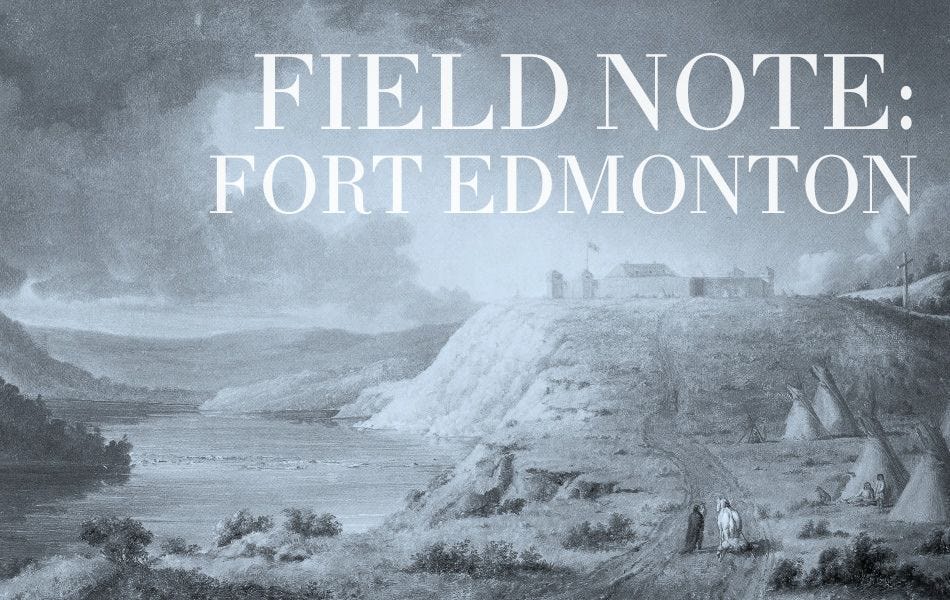
Fort Edmonton by Paul Kane, 1849–56 (original in colour)
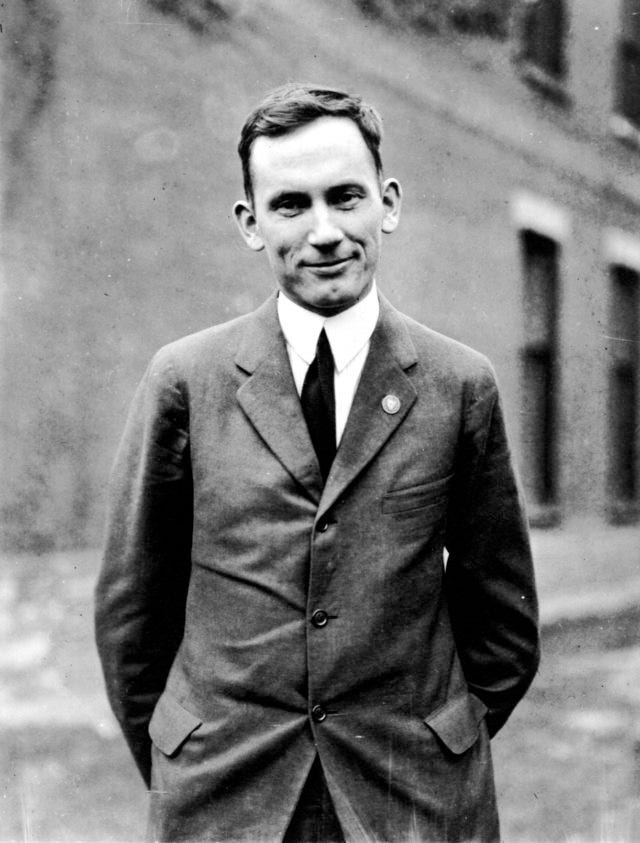
Harold Innis, from “The Tyranny of Now,” Nicholas Carr, The New Atlantis, Winter 2025
https://www.thenewatlantis.com/publications/the-tyranny-of-now
Thank you for this superb piece on Edmonton history. Don’t know if you’ve seen my children’s book Rutherford the Time-travelling Moose, commissioned by the Friends of Rutherford House Society, in which I attempted to encapsulate the history of Edmonton in 32 pages for preschoolers. Illustrated by local artist Amanda Schutz.
Marshall McLuhan was born in Edmonton 😎👍🍻